Why You Can’t Stop Doomscrolling (And What It’s Quietly Doing to Your Mental Health)
Roy Lam
MBACP Registered Therapist
24 March 2026🕒 6 min read
You told yourself you’d just check the news for a moment. Forty-five minutes later, you’re reading about something that happened on the other side of the world, feeling vaguely sick, and wondering why you feel worse than you did before you picked up your phone.
If this sounds familiar, you are not weak-willed or unusually anxious. You are, in fact, doing something your brain was specifically designed to do. The problem is that the design is very, very old, and the world it evolved for no longer exists.
What Doomscrolling Actually Is
Doomscrolling is the compulsive consumption of negative news and content online, often continuing long past the point where you’ve stopped taking anything useful in. The word itself only entered widespread use during the pandemic, but the behaviour is everywhere now: news feeds, social media timelines, comment sections, trending threads, all of it organised by algorithms whose purpose is to keep you there.
Research published in early 2026 found that doomscrolling isn’t simply a bad habit in the way that eating too many biscuits is a bad habit. It maps onto the same psychological mechanisms as anxiety disorders, specifically what researchers call intolerance of uncertainty: the feeling that if you just keep looking, you might find something that finally makes the threat feel manageable. You rarely do. But the urge to keep checking persists anyway.
Your Brain Is Doing Its Job. Badly.
Here is something worth understanding: the part of your brain driving this behaviour is not malfunctioning. The amygdala, the brain’s threat-detection centre, is doing exactly what it evolved to do. It is scanning the environment for danger, flagging anything that looks threatening, and keeping your attention locked onto it until it feels resolved.
The difficulty is that it evolved for a very different information environment. In the ancestral world, a threat was local, immediate, and resolvable. You could act, flee, or wait for it to pass. Today’s news cycle delivers an unending stream of threats from across the globe, most of which we have no power to influence. The amygdala doesn’t distinguish between a predator near the camp and a political crisis unfolding on another continent. It registers threat, floods the body with cortisol and adrenaline, and keeps attention fixed, waiting for a resolution that never comes.
The Mental Health Foundation notes that heavy doomscrolling is linked to higher levels of anxiety, depression, and a gradual erosion of life satisfaction. Over time, it can distort your sense of reality, making the world feel more threatening and hopeless than it actually is.
What It Does to Your Sleep
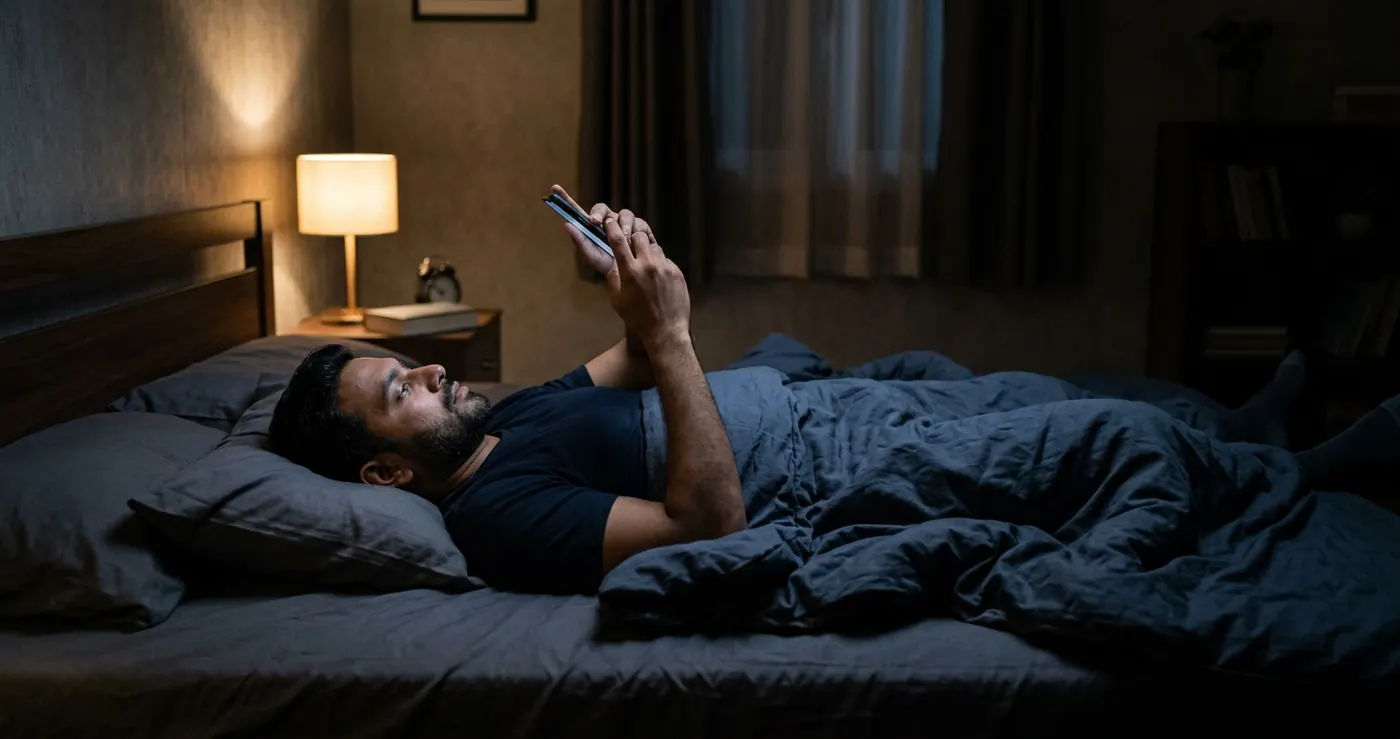
One of the most direct and underreported consequences of doomscrolling is what it does to sleep. When you scroll distressing content late at night, the brain does not simply switch off when you put the phone down. It remains in a state of heightened alertness: cortisol elevated, thoughts racing, the nervous system still scanning for a danger it has not resolved.
The result is delayed sleep onset, fragmented sleep, and a kind of non-restorative rest that leaves you tired but not refreshed. When you wake tired and anxious, the urge to check the news again, to regain some sense of control, is even stronger. And so the cycle continues.
This is not about screen time in the abstract. It is about what your nervous system does with the content it has consumed, and how hard it is to move from that activated state into genuine rest.
Often what keeps us scrolling isn’t curiosity. It’s the discomfort of stopping. Therapy can help you sit with that discomfort and discover it’s far more manageable than it seems.
The Part That Willpower Can’t Fix
If you have ever tried to just stop scrolling, to put the phone away by force of will, you will know that it rarely works for long. That is because doomscrolling is not primarily a willpower problem. It is a regulation problem.
The urge to scroll is, at its root, an anxiety response: a way of managing the discomfort of uncertainty by seeking information. Telling someone to stop doomscrolling without addressing the underlying anxiety is a little like telling someone with a fear of heights to just look down. The behaviour is a symptom, not the cause.
The Mental Health Foundation recommends limiting news consumption to set times of day, curating your feeds, and building news-free periods into your routine. These are genuinely useful starting points. But for many people, especially those whose anxiety runs deeper, they are not enough on their own.
What Therapy Can Offer
What therapy provides, particularly approaches like CBT and Emotion-Focused Therapy, is not a set of rules to follow but a genuine shift in how you relate to uncertainty and discomfort. In sessions, we can explore:
What the scrolling is protecting you from. For many people, the phone comes out in moments of quiet, when there is nothing between them and their own thoughts. Understanding what those thoughts are, and why they feel so difficult to sit with, is often where real change begins.
How to build genuine nervous system regulation. Not suppression, not distraction, but the capacity to feel anxious without being overwhelmed by it. This is a learnable skill, and one that has lasting effects far beyond screen time.
The beliefs that keep the loop running. Often there is a hidden logic beneath the scrolling: if I stay informed, I’m in control; if I stop watching, something will catch me off guard. These beliefs are worth examining with curiosity rather than judgment.
The UK government is currently consulting on whether to ban infinite scroll and other addictive design features from platforms used by children, citing harm to mental health and development. That is a meaningful policy step. But the adults who have spent years being shaped by these same features deserve support too, and that support exists.
A Note on Being Kind to Yourself
If you recognise yourself in this post, it is worth remembering: you did not design your nervous system, and you did not design the platforms that exploit it. The architecture of social media is built by teams of engineers whose stated job is to keep you scrolling for as long as possible. You are not failing to exercise willpower against a neutral technology. You are pushing back against systems specifically engineered to undermine it.
That is worth acknowledging. And it is also a reason to seek support that matches the scale of what you are up against, not just another tip, but a genuine space to understand yourself and build something more resilient.
Recognise the loop?
I work with individuals across the UK and internationally via online sessions on Google Meet. If any of this feels familiar, you’re welcome to start with a free 15 to 30 minute consultation: no commitment, just a conversation.
 24 March 2026
🕒 6 min read
24 March 2026
🕒 6 min read